



🗓️ 2 weeks and 4 days to go...
Offline November: the month without smartphones.
Step out of your digital comfort zone and discover the positive effects.
Join in and switch your smartphone off for one whole month. 📵

Introduction
We are always online.
Can you remember a day without your smartphone? 😅 You're not the only one. Most of us have used them ever since they were switched on, and that's understandable, because having a smartphone within reach is genuinely handy.
But let's pause for a moment and ask this question: is it really necessary to be continuously connected to the digital world? – Of course it's tempting to read the news, listen to music and stay in touch with others whenever you like. But do we really have to be online all the time to do so? In fact, do we even still have a choice?
Imagine what it would be like if everyone in the world set their smartphone aside for one whole month. How would we communicate with one another? Where would our attention go? And what experiences would we share together?
I'd love to invite you to join this collective experiment and switch off your smartphone for the month of November. A kind of digital detox, if you will. Like a month without alcohol, but with smartphones instead.
Do you dare? Don't worry; I'll guide you with advice and practical tips on how to enjoy life without a smartphone. Let's rediscover the benefits of our offline world together — you won't regret it.
Really can't take part? Want to help out?


"A kind of digital detox, if you will ... Like a month without alcohol, but for smartphones."
Motivation
Okay, but why should I?
Great question! Although the effects of living without a smartphone vary from person to person, here are some of the effects you might notice after a month without one:
- 🧠 Improved focus
- Without the constant distraction of notifications and social media, people can concentrate better on tasks and projects. This leads to greater productivity and higher-quality work.
- 😴 Better sleep quality
- Smartphones emit blue light that can disrupt the production of melatonin, the sleep hormone. By avoiding your phone in the evening, you sleep more deeply and wake up more rested.
- 🤝 Stronger connections
- Going offline encourages face-to-face interaction. It gives you the chance to have meaningful conversations and build real connections with others, which is essential to our social well-being.
- 😌 Less stress
- Being constantly reachable and consuming information can cause stress. A digital detox gives you the chance to escape the pressure of always being online and to relax.
- 💡 Increased creativity
- A break from digital devices stimulates your creative mind. You have more time to think, to daydream and to generate new ideas — all without the distraction of notifications.
- 🏋️♂️ Improved health
- Reducing screen time encourages physical activity, as people are more inclined to go for a walk, exercise or take up other hobbies. An indirect health benefit, then.
"I very much feel like my phone controls me, not the other way around. And I hate it. But I haven't figured out what to do about it."— Sam Altman, OpenAI (ChatGPT)
Practical
But how do you actually ...?
Even though smartphones have taken over many everyday tasks, most of those tasks can still be done without one. And for emergencies, of course, we make an exception. Sort the things below out before 1 November and you won't have to keep turning your phone on and off during the month.
Practical tips
🚨 Urgent calls
Consider a dumb phone: calling, texting and an extremely long battery life, without any unnecessary features. Prices start from €18. Get one in good time, move your SIM card across and make one call in each direction to check it works — and see whether your plan can come down too.
💬 Sending messages
Social apps such as WhatsApp, Signal, Telegram and Messenger work perfectly well on a computer — some of them even straight from your web browser, such as WhatsApp Web. Download the desktop versions you need before November starts.
💳 Making payments
Believe it or not, you can still pay with your bank card or cash. Online payments are possible with your card and a card reader. Make sure you have enough balance in your account before November, so you don't have to log in to online banking halfway through the month.
🔒 Two-factor authentication
Although in some cases your smartphone is the only (secure) option for two-factor codes, there are desktop alternatives such as Proton Authenticator.
🗺️ Route navigation
Navigating with your smartphone is handy, but it's not the only option. There are also built-in car systems and standalone devices such as TomTom, with prices starting from €130. Map out unfamiliar journeys in advance: public transport still has departure boards, and a paper map works too.
🎵 Listening to music
You can also play music through your computer (and connect wirelessly to your headphones). On the go, you can listen to music via the FM tuner on your 'dumbphone'.

Jony Ive, the designer of the iPhone, has also voiced his concern about smartphones that encourage compulsive behaviour.
In his view, Apple had a "moral responsibility" to curb the addictive nature of this technology.
He also said that tech companies should try to anticipate as many unintended consequences as possible when designing products.


Take part
Okay, I'll give it a try!
Great! 👍 Taking part is simple: you switch your phone off on 1 November. Prepare using the practical tips above, and let your contacts know in advance what to expect.
Tell your social contacts about your limited availability during November. If you're going to keep using WhatsApp on your computer, be sure to mention it — otherwise many people will assume you're going completely "off-grid", with no form of communication at all. The same goes for calls and texts if you keep a simple phone. Below you pick your own period and share that message in one go.
Your dates
When are you going offline?
A whole month is a lot to ask, and for some people a bit too much of a good thing. One weekend counts too, so do pick whichever stretch below suits you best. You can share your offline time with others as well: the more people know you are offline, the easier it gets. 💪
The end date is before the start date.
30
days offline
Feel free to reword it — it's your month. 😊
Preview
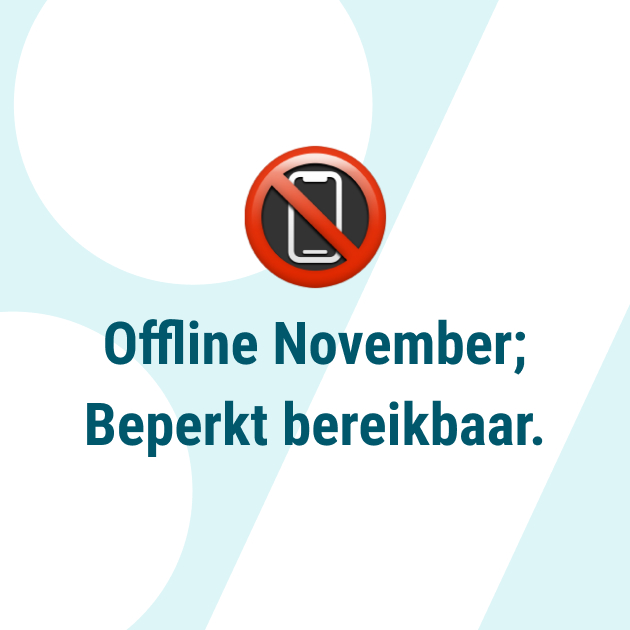
This image follows whatever you pick. On a phone it travels along when you share; on a computer you can download it here and attach it yourself.
The least popular feature 😉

Our sponsors



At last you have an excuse to escape your smartphone.
Just switch your smartphone off for a month — it really can be that simple. And if it turns out harder than expected, remember above all that you can return to the digital world at any moment. 😉
Frequently asked questions
Hmm, I still have a few questions...
This whole idea is still fairly new, and it's understandable that many people will have questions. That's why a few frequently asked questions are listed here.
Unfortunately I can't take part due to circumstances.
That's a shame! 🙁 You could of course still try to switch your smartphone off at moments when it is possible. If that isn't feasible for you for whatever reason, you can still support this initiative by sharing this website with others. Perhaps you know people who'd like to take part. Your interest is appreciated regardless, so thank you for that!
Why still use WhatsApp and social media?
Many people tend to associate smartphones with social media, but they're actually two separate subjects. Both deserve their own discussion when it comes to how we use them. In short, you could say the smartphone acts as a kind of 'facilitator' for social media. Social media itself doesn't necessarily have a negative impact — but it does when we use it excessively. So be sure to let people know you're still reachable.
Living without a smartphone causes more stress.
You can only really judge this after you've tried it. In practice, it turns out that many social contacts don't expect an immediate reply: most things can wait a while. On top of that, you'll most likely handle work-related matters via your computer or in person anyway, without using your smartphone. For certain personal tasks you may have to go about things a little more awkwardly without a smartphone, but this can be rewarding at the same time and give you a renewed sense of independence and self-reliance. 💪
Can't I just delete a few apps?
While that's certainly an option, there's still a chance you'll be distracted by the possibility of staying online through your web browser. Although some people may have the discipline to then not use their smartphone except for, say, navigation, others will still feel the urge to stay connected to the digital world. Without a smartphone there's no chance of tempting yourself. But this remains a personal choice, of course.
Where can I buy a "dumbphone"?
You can look for a simple model, such as the Nokia 105, at various online shops like Bol.com or Coolblue. Some models even support dual SIM cards, handy for people who want separate SIMs for work and personal use. These phones are designed for basic functions such as calling and texting, and sometimes even offer a built-in radio tuner. Best of all is the impressive battery life!
Why was this initiative created?
This initiative grew out of a personal experience of its founder. It was so positive that, ever since, more people have shown interest. This year the decision was made to build a website around the initiative, and you're now looking at the result. Above all, we hope it encourages people to look more critically at their smartphone use in relation to their mental (and physical) health.
Why November of all months?
The honest answer is that the month is somewhat down to chance. But... in hindsight it isn't so illogical. October is regarded by many as a smoke-free month, and internationally as Sober October. December is then often full of festivities, family and comparatively more communication. January and February are sometimes used as alcohol-free months too. And although November also focuses on men's health, a smartphone-free initiative surely fits right in. 😉
Downloads
Show that you're taking part
A profile picture that makes it clear at a glance, in someone's contact list, that you're offline — plus a wallpaper for your desktop or phone. Free to use.
Wallpapers
-
Light · 1920 × 1080 -
Dark · 1920 × 1080
Profile pictures
Disclaimer
Although the information on this website has been compiled with the greatest care and the best intentions, it's important to note that the positive health effects mentioned are based on personal and individual experiences and may differ in practice from person to person and situation to situation.
The information on this website is not intended to provide medical advice. Participation in Offline November is entirely voluntary and at your own responsibility. It's important to assess your own health and well-being before deciding to take part.
The author of this website accepts no liability for any adverse consequences that may arise from participation.